Perfectly Personalized, Completely Replaceable · Excerpt
Chapter 1: The Decision Is Changing
The opening pages of the first chapter, as published. The book continues with the two games retailers now play, the Customer Growth Map and seven more chapters, with a toolkit for leadership teams.
Holloway & Co. is a mid-sized European lifestyle retailer: around 300 stores selling fashion, beauty and home, a growing online business, an app and a loyalty program called Holloway Club. It is fictional, but its problems are real, and it appears in every chapter of this book. Teresa Lind runs its CRM and loyalty team.
In three years, Teresa had built what most customer teams only present at conferences: a best-in-class CRM platform, three million Holloway Club members with unified profiles, first-party data flowing from tills, app and website, and emails assembled from hundreds of variations, each one looking as if it had been written for the person receiving it. For most of those three years, the numbers rewarded her: open rates up year after year, more sales attributed to campaigns every quarter, online orders growing steadily. Those were the figures she brought to the executive committee whenever she was asked for an update.
Then, over six months, the numbers started to move the wrong way. Open rates slipped. Conversion fell faster, most visibly in the campaign that mattered most that year: inviting store customers to try the app, with a welcome voucher for their first online order.
The team checked the usual suspects. Sending frequency had not changed. Deliverability was fine. Unsubscribes were flat. Nothing in the machine was broken.
So Teresa asked the team to survey the customers who had received the invitation and not ordered: a short questionnaire by email, ending with one open question — what stopped you? The answers were strikingly similar. They had been interested, but they had questions. Will it fit me? Can I return it in store? What if the shade doesn’t suit my skin? The email had not answered them, so they had asked somewhere else. “I asked my phone,” wrote Claudia, a Holloway Club member who had bought her beauty products and much of her wardrobe at Holloway & Co. for years. “It’s quicker.”
That gave Teresa two problems, not one.
The first was inside her own channels. The email told customers what Holloway & Co. wanted them to do. It did not help them decide. So the team set out to build something Holloway & Co. had never had: a shopping assistant with a single job, answering questions about buying online — sizes, returns, delivery. Rather than build it in-house, they worked with a specialist start-up. The technology turned out to be the easy part. The hard part was the information the assistant had to rely on: size guides that differed between the website and the stores, a returns policy described three different ways, delivery times that showed up only at checkout. Putting that right took longer than building the assistant. It launched first for the customers being invited to try the app from then on, and the invitation was rewritten around it: same voucher, but now an invitation to ask anything and get an answer on the spot. A narrow first use case, with a large idea behind it: moving from impacting the customer to helping the customer decide.
The second was outside. Teresa asked the team to put customers’ questions to the main AI assistants themselves. Where can I get a dress tailored in time for a wedding on Saturday? Which store near me can help me choose a foundation for sensitive skin? Holloway & Co., whose beauty advisers its customers swore by, barely appeared. Its website ranked well on Google. But a security setting on the site was blocking AI crawlers, and nobody had noticed. And the facts an assistant needed to recommend Holloway & Co. (how its sizes fitted, what its returns policy was, which store had a product in stock) were nowhere written as plain answers. The size guides sat in images, and stock only appeared after a customer had chosen a store. For search, neither had mattered much: the page still ranked, and a customer who landed on it could find the rest herself. An assistant answering on her behalf usually could not. Holloway & Co.’s strength was real, but invisible to the systems now helping customers choose. Claudia had placed her first online beauty order with a competitor her phone had recommended. And for customers who did not already know it, Holloway & Co. simply did not exist. Olivia, who lived ten minutes from one of its flagship stores, asked an AI assistant on her phone where she could try on a dress for a friend’s wedding, under 150 euros, that week. She wanted to see it on before buying. She never heard the name Holloway & Co.
Holloway & Co. had become perfectly personalized. Inside its own channels, customers were looking for help it did not offer. Outside them, machines were choosing without it — and wherever a machine did the choosing, Holloway & Co. was completely replaceable. More personalization would solve neither problem.
Twenty years of change, one constant
I started my career in marketing in 2006, working on global consumer brands, when television still built brands and understanding consumers meant panels, surveys and focus groups. Years later I crossed to the other side of the shelf, into retail, CRM and loyalty. In the twenty years since I started, almost everything about the job has changed. Search made information instant. Ecommerce let customers compare dozens of retailers without leaving home, and buy from any of them at any hour. Social platforms gave customers a public voice, and smartphones made access permanent.
Companies have gained capabilities that would have sounded like science fiction when I started: identified transactions, measurable interactions, rich first-party data and the ability to tailor an experience to each individual. Now AI is changing the relationship again. It expands what companies can understand and automate. It also gives customers new ways to discover, compare and, more and more, delegate their decisions.
Through all of it, one thing has not changed. Marketing exists to understand what people value, build a proposition that earns their preference and turn that preference into sustainable growth. Put simply: give as many relevant customers as possible a compelling reason to choose you — again and again, and profitably.
What is changing is the environment in which that choice is made — and, as Holloway & Co. discovered, who is making it.
The customer-centricity paradox
Over the last decade, companies have invested heavily in putting the customer at the center, and the progress is real. We recognize customers across channels, track how their behavior evolves, predict what they will do next and adapt experiences with remarkable precision. Customers have barely noticed. In Forrester’s 2026 Customer Experience Index, 91% of the European brands measured showed no significant change from the year before.1
But look at how most customer initiatives still begin. Ecommerce wants to accelerate app adoption. A category team wants to launch a new skincare range. A new service needs sign-ups. A commercial team wants a double-points weekend. Someone has a retention target to hit. Each is a legitimate business objective, and each arrives in the CRM team as a brief. Each comes with its own target, and none of those targets measures the customer’s relationship with the company as a whole. The team closest to the customer is often the one with the least say over what reaches them.
Only then does customer intelligence enter the process. Who should receive this? Which customers have the highest propensity? Which offer, which channel, which moment, which version of the creative? Data and technology have made every one of those answers more sophisticated. A skincare campaign can now reach the members most likely to buy, through the channel each of them prefers, with products matched to what each of them has bought before.
The customer is deeply embedded in the execution. But the most important decision is made before the customer enters the room: the initiative itself.
The customer is at the center of the execution. The initiative is still at the center of the decision.
That is the customer-centricity paradox. We have become extremely good at answering one question: who is the right customer for this initiative? It is a valuable question, and it will remain one. But the more powerful question runs the other way: what is the right initiative for this customer?
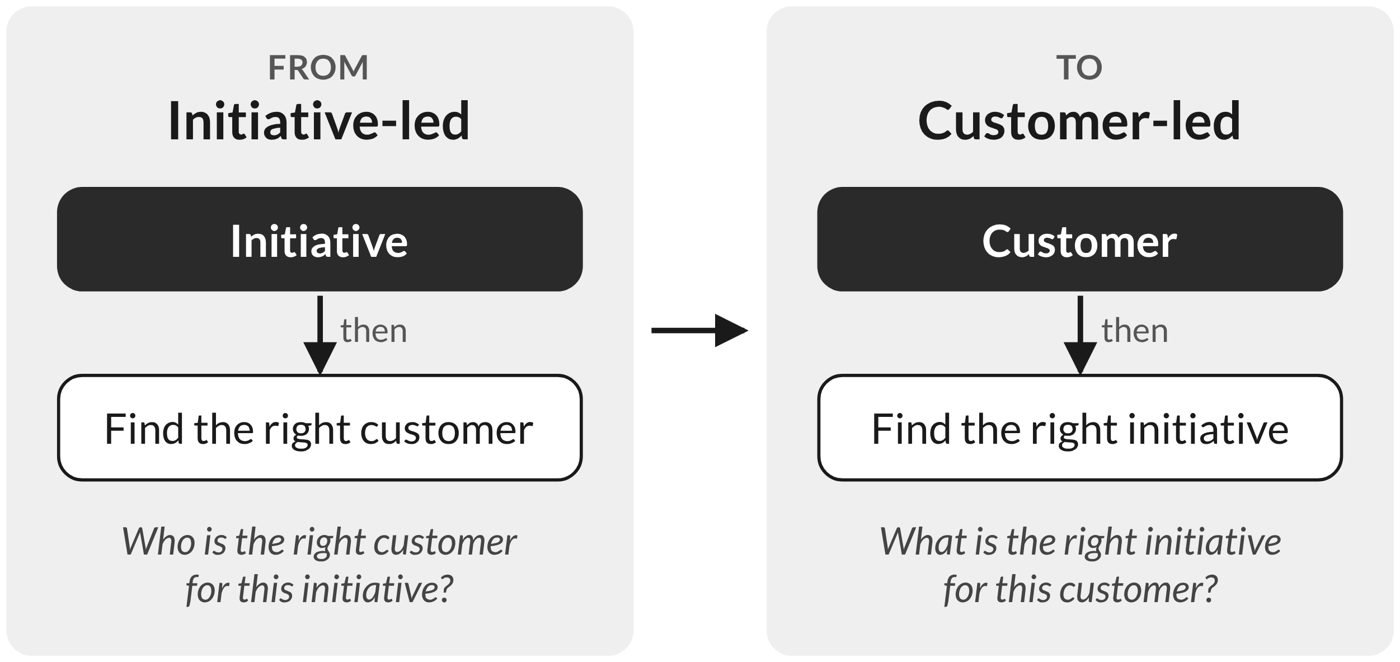
This is not an argument against initiative-led marketing. Brands will still be built, products launched and campaigns run at scale, because some value only exists at scale. The point is narrower and more demanding: to know when a decision gets better by starting with the customer, and to build the capability to make it that way.
Decision intelligence moves to both sides
Technology has helped companies decide for years. Propensity models estimate who will respond. Recommendation engines choose products. Optimization systems prioritize audiences, offers and timing, and marketing automation turns those choices into action. AI accelerates all of it.
The more consequential change is happening on the other side of the relationship. Customers have more choice and less patience for effort. Search lowered the cost of finding information, reviews lowered the cost of trusting it, and comparison sites lowered the cost of weighing alternatives. AI assistants now lower the cost of the hardest step: interpreting the options, understanding the trade-offs and reaching a decision. In a McKinsey survey of consumers in France, Germany and the UK at the end of 2025, 38% said they already used AI tools to research products and decide what to buy.2 And these tools work with context no search engine ever had. People no longer type three keywords; they describe their situation — who it is for, the budget, the deadline, what matters to them — and the answer is built for them. Olivia did not search for “wedding guest dress”. She asked where, near her home, she could try on a dress for a friend’s wedding, under 150 euros, that week. Emerging agents go one step further: they can act on the decision for the customer, up to placing the order.
Claudia and Olivia did not face the market alone. AI assistants did most of the work. Decision intelligence now sits on both sides of the customer relationship, and that changes what it takes to win.
Continue reading
The rest of Chapter 1, and the full book, are available on Amazon.
- Forrester, “Have We Turned The Corner On CX Quality?” Forrester blog, June 8, 2026. forrester.com
- Katharina Schumacher, Marcus Keutel, and Philipp Kluge, “Europe’s agentic commerce moment: Decision influence is here; execution is coming,” McKinsey & Company, March 2, 2026. mckinsey.com
Copyright © 2026 Berta Martínez. All rights reserved. Holloway & Co. and all the people who work for or shop at it are fictional composites.